Lesson 1
Polish alphabet
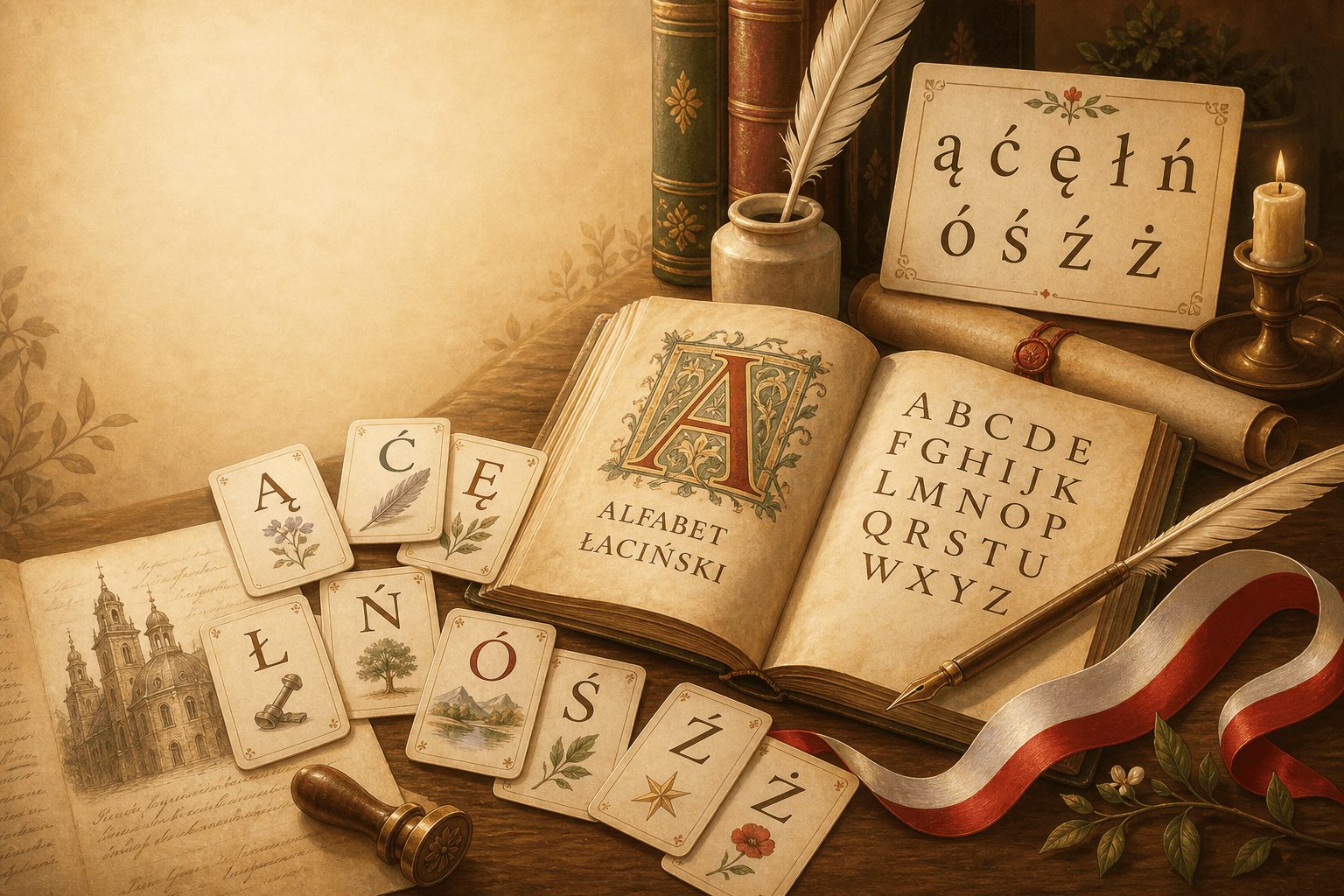
A short history of the Polish alphabet
Polish belongs to the Slavic language family, but for many centuries it has been written with the Latin alphabet. This is connected above all with the year 966, when Poland adopted Christianity from the West. Together with the religious and written Latin tradition, the letters of the Latin alphabet also arrived.
Polish had sounds that did not exist in Classical Latin, so over time special signs were added: ą, ć, ę, ł, ń, ó, ś, ź, ż. These signs make Polish spelling look unusual at first, but they also make pronunciation more precise.
Today the Polish alphabet has 32 letters. Q, V, and X are not part of the basic Polish alphabet; they appear mainly in foreign words, proper names, and international terms. In spelling, Q is called ku, V is called fał, and X is called iks.
Listen and read
0:00 / 1:32
Speed
Read the text
Lesson notes
Small pronunciation details that appear in the text.
These notes explain the numbers that appear in the text.
Ą is nasal
Ą is nasal. In ząb, start with an open o sound and finish with a light n.
Ć is soft
Ć is close to ch in cheese, but shorter, softer, and made farther forward.
Ę is nasal too
In ręka, ę is close to eng in length before k. Keep it short and do not over-nasalize it.
Ł in words
In words like łódź, modern Polish ł sounds like w in water. Use that word sound here; the isolated letter may sound different.
Ń is soft n
Ń is a soft n, close to ny in canyon. Keep it as one smooth sound.
Ó sounds like u
Ó sounds like oo in boot. In mój it is written ó; in some other words the same /u/ sound is written u.
Ś is soft
Ś is like sh in she, but thinner and softer. Keep the tongue high.
Y is called igrek
When naming or spelling the letter Y, say igrek. In a word such as my, y keeps its Polish vowel sound.
Ź is soft voiced
Ź is the voiced version of ś, close to a softer s in vision. Keep it light.
Ż is hard voiced
Ż is close to the s in measure or vision, but firmer and farther back than ź.
Cz is hard
Cz is like ch in chocolate, but firmer. Keep the two letters together.
Sz is wider
Sz is like sh in shoe. It is fuller and a little farther back in the mouth than ś.
Rz sounds like ż
In standard Polish, rz and ż have the same sound. The spelling is the part you memorize by word.
Dź is soft
Dź is close to j in jeans, but softer and lighter. Say it as one short sound.
Dż is hard
Dż is close to j in jam, but firmer. Keep the two letters together.
Ch is one sound
Ch is one rough sound, like ch in Scottish loch or German Bach. In standard Polish, ch and h sound the same, so hearing alone does not reveal the spelling.
Dz is one sound
Dz is one quick sound, like ds in beds. Start with d and release into z without a pause.
Q, V, and X in foreign words
Learn their Polish letter names and recognize them in borrowed words.
Q, V, and X do not belong to the 32-letter basic Polish alphabet. They appear mainly in loanwords, foreign names, brands, and abbreviations.
When spelling, say Q as ku, V as fał, and X as iks. Inside a borrowed word, pronunciation may follow the source language, so learn the whole word together with its sound.
X often represents the sound ks in foreign names and brands, as in Hortex. In regular Polish spelling, this sound is usually written with the two letters ks, as in tekst and taksówka.
| Letter | Name when spelling | Example in a word |
|---|---|---|
| Q q | ku | quiz: [kfis] or [kłis] |
| V v | fał | VAT: v sounds like Polish w |
| X x | iks | Hortex: x sounds like ks |
The same sound, different spelling
Recognize three common pairs that cannot be distinguished by sound alone.
In standard Polish, rz and ż, ó and u, and ch and h are pronounced the same. Hearing the sound is not always enough to know the spelling.
A related word can sometimes give you a clue. When there is no clear clue, learn the spelling together with the whole word.
| Same sound | Examples | First spelling clue |
|---|---|---|
| rz / ż | Rzym, żaba | rz can alternate with r: morze – morski. ż can alternate with g or z: książka – księga, wożę – wóz. |
| ó / u | mój, mur | ó can alternate with o, e, or a: mój – moja, stół – stoły. The letter u is also called u otwarte; ó is called o z kreską or u zamknięte. |
| ch / h | chleb, hotel | ch can alternate with sz: mucha – muszka, ucho – uszy. H often appears in loanwords such as hotel and historia. |
How to spell names and other words
Say the Polish name of each letter separately.
Use Jak to się pisze? to ask how something is written. Use Proszę przeliterować. when you want the other person to spell it letter by letter.
First say the Polish name of the letter: a, en, wu, igrek. If a letter is still unclear, add jak and a familiar name or word: A jak Anna, M jak Maria, K jak Kraków. You do not need to give a helper word for every letter immediately.
| Purpose | Polish | Meaning |
|---|---|---|
| Ask about spelling | Jak to się pisze? | How do you spell that? |
| Ask someone to spell | Proszę przeliterować. | Please spell it. |
| Clarify one letter | A jak Anna. | A as in Anna. |
Basic punctuation and capital letters
Write short Polish sentences clearly.
Start a sentence and proper names with a capital letter: Anna Kowalska, Warszawa, Polska. Nationality nouns also begin with a capital letter: Polak, Brazylijka. Write common words, weekdays, months, language names, and adjectives with a lowercase letter: dom, poniedziałek, styczeń, polski, brazylijski.
Do not put a space before a full stop, comma, question mark, exclamation mark, or colon. Put one space after it when the sentence continues.
| Sign | Polish name | Use |
|---|---|---|
| . | kropka | ends a statement |
| ? | znak zapytania | ends a question |
| ! | wykrzyknik | shows strong emotion or emphasis |
| , | przecinek | separates items or parts of a sentence |
| : | dwukropek | introduces a list or explanation |
| „ ” | cudzysłów | marks a quotation or a word being discussed |
Word stress in Polish
In most words, stress the second-to-last syllable.
Word stress identifies the syllable pronounced more clearly. In most Polish words, it falls on the second-to-last syllable: POL-ska, ko-BIE-ta, te-LE-fon, War-SZA-wa. A one-syllable word stresses its only syllable: DOM, TAK.
Stress is not normally marked in Polish spelling. Signs in letters such as ó, ć, and ń are not stress marks; they form a different letter or change its sound. The bold type and capital letters below are only pronunciation aids.
There are exceptions. In many words ending in -ika or -yka, stress falls on the third-to-last syllable: gra-MA-ty-ka, ma-te-MA-ty-ka, MU-zy-ka. It also falls there in past-tense forms ending in -śmy or -ście: ro-BI-liś-my, BY-liś-cie. Apply the second-to-last-syllable rule first and learn frequent exceptions together with the sound of the whole word.
| Pattern | Stress | Examples |
|---|---|---|
| Most words | second-to-last syllable | POL-ska · ko-BIE-ta · te-LE-fon |
| One-syllable words | the only syllable | DOM · TAK |
| Many words ending in -ika / -yka | third-to-last syllable | gra-MA-ty-ka · MU-zy-ka |
| Past forms ending in -śmy / -ście | third-to-last syllable | ro-BI-liś-my · BY-liś-cie |
Voiced consonants at the end of a word
At the end of an isolated word, a voiced consonant normally sounds voiceless.
Polish has pairs of voiced and voiceless consonants. When a word is pronounced on its own or before a pause, a voiced consonant at the end normally loses its voicing and sounds like its voiceless partner. This is called final devoicing: b → p, d → t, g → k, w → f, z → s, ź → ś, ż/rz → sz, dz → c, dź → ć, dż → cz.
The spelling does not change. Write chleb with b even though by itself it sounds like [chlep]. A related form can reveal the written consonant: chleb – chleba, kod – kodu, Bóg – Boga. The pronunciation in square brackets below is simplified and serves only as a listening guide.
| Spelling | Heard in an isolated word | Helpful form |
|---|---|---|
| chleb | [chlep] | chleba |
| kod | [kot] | kodu |
| Bóg | [buk] | Boga |
| staw | [staf] | stawu |
| raz | [ras] | razy |
| mąż | [mąsz] | męża |
| łódź | [łuć] | łodzi |
Ę and ą at the end of a word
Final ę is oral or only lightly nasal; final ą keeps audible nasal resonance.
Do not omit final ę. In careful pronunciation it sounds like e with very light nasal resonance; in everyday speech it may sound like a plain e: idę, robię, proszę, dziękuję. A strong fully nasal ę sounds unnatural. Do not add m or ł: not [idem] and not [ideł].
Final ą keeps audible nasal resonance in standard pronunciation. It may be slightly weaker than inside a word, but it does not become plain o, om, or oł: idą, robią, proszą, czekają. Use this rule consistently whenever ą occurs at the end of a word.
| Ending | How it sounds | Examples |
|---|---|---|
| -ę | e or very lightly nasal e; never [em] or [eł] | idę · robię · proszę · dziękuję |
| -ą | audible nasal resonance; never [o], [om], or [oł] | idą · robią · proszą · czekają |
Vocabulary review
Classify this lesson's words to organize what you should review later.
- 0
- Easy
- 0
- Hard
- 0
- I know it
Lesson exercises
Practice listening, sounds, and spelling with this lesson.
Exercise 1 of 10

Listen and choose the letter.
Play audio