Lesson 2
People in Polish
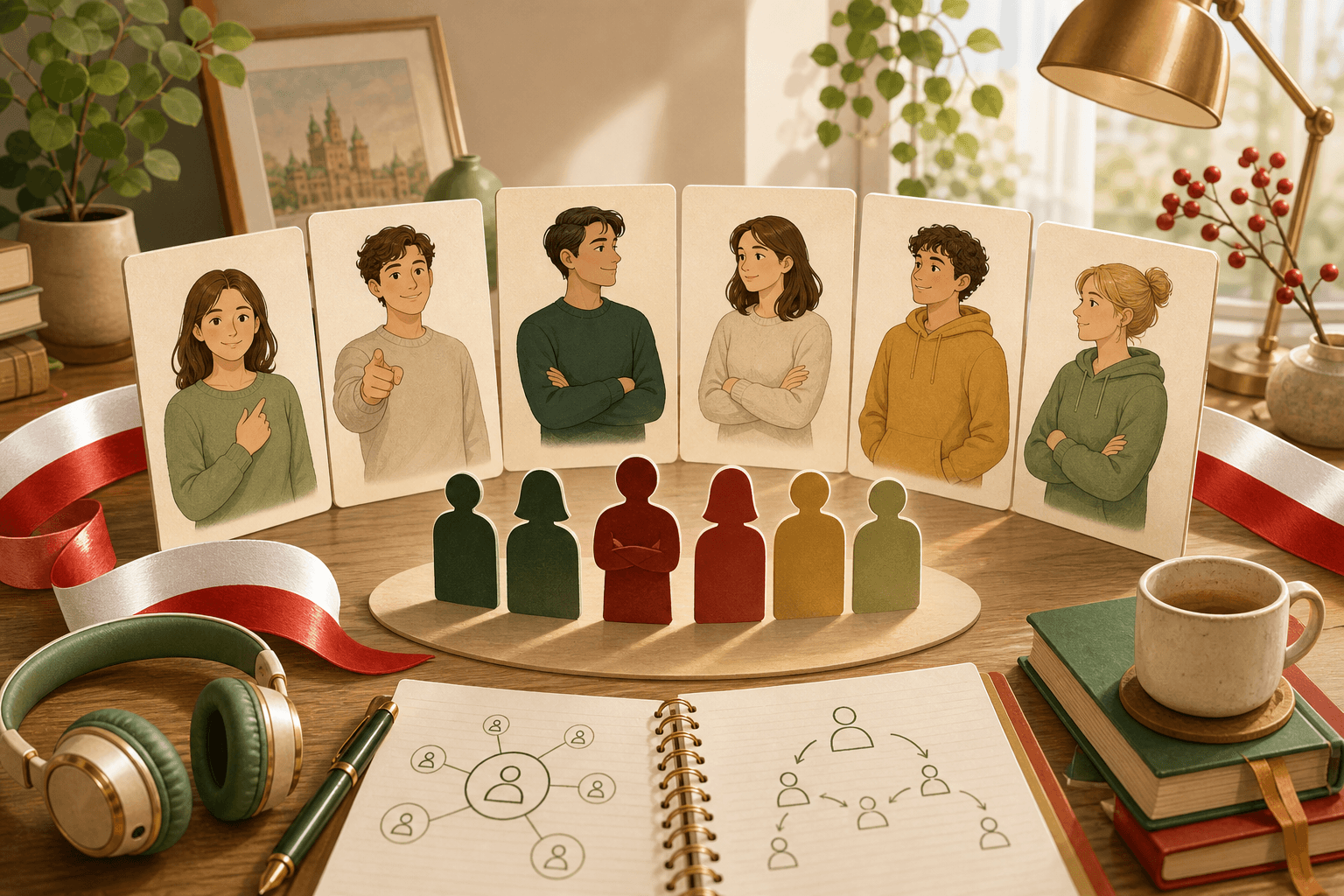
People in Polish
You learn how Polish names people in speech: the speaker, the listener, one person, and groups of people.
The lesson introduces simple identification, basic pronouns, and the first forms of to be so you can say who someone is.
Lesson warmup
Warm up with the song
Listen once before practice to get into the rhythm of the lesson and recognize the key words.
Lesson song
Ja to ja
A lesson song to repeat the people words, the pattern to, and the first forms of być with rhythm.
Listen and read
0:00 / 0:56
Speed
Read the text
After practice
Continue with the podcast
After the main experience, listen to the podcast to meet the same topic in another context.
Companion podcast
8:38Ja, ty, on, ona — osoby w polskim
A slow Polish-only episode about personal pronouns, the verb być, Polish genders, and the word to.
The word to
Presenting and defining
Before the person words, it is useful to understand to. It is a small pointing word. In this lesson, it helps you say that one thing is another thing.
You see it in two patterns: X to Y for simple definitions, and To jest... for presenting a person, animal, or thing.
At this stage, treat each pattern as a useful whole, not as a word-by-word translation.
| Pattern | Use | Example | Meaning |
|---|---|---|---|
| X to Y | simple definition | Ja to ja. | I am me. |
| To jest... | present someone or something | To jest kobieta. | This is a woman. |
Singular people
ja, ty, on, ona, ono
For basic definitions, Polish can use X to Y: On to mężczyzna, Ona to kobieta, Ono to dziecko.
For polite introductions with names, use pan and pani: To jest pan Adam, To jest pani Ewa.
| Word | Meaning | Lesson example | Translation |
|---|---|---|---|
| ja | I | Ja to ja. | I am me. |
| ty | you | Ty to ty. | You are you. |
| on | he | On to mężczyzna. | He is a man. |
| ona | she | Ona to kobieta. | She is a woman. |
| ono | it | Ono to dziecko. | It is a child. |
| pan | sir; polite he | To jest pan Adam. | This is Mr. Adam. |
| pani | ma'am; polite she | To jest pani Ewa. | This is Ms. Ewa. |
Plural people
my, wy, oni, one, państwo
Before the full być table, learn who the plural person words refer to.
These examples still use the simple pattern X to Y. In the next note, you will connect the same words with jesteśmy, jesteście, and są.
| Word | Meaning | Lesson example | Translation |
|---|---|---|---|
| my | we | My to ja i ty. | We are me and you. |
| wy | you all | Wy to ty i ty. | You all are you and you. |
| oni | they (men or mixed) | Oni to on i on. | They are he and he. |
| one | they (women, children, or things) | One to ona i ona. | They are she and she. |
| państwo | you all (polite) | Państwo to pan i pani. | Państwo means pan and pani. |
The verb być
być means to be
Być means to be. Each person gets its own form — Polish does not use one form for everyone.
Ja jestem, ty jesteś, on jest. For the plural: my jesteśmy, wy jesteście, oni są.
Polite forms follow the same pattern: pan jest, pani jest, państwo są.
| Person | Form of być | Translation |
|---|---|---|
| ja | jestem | I am |
| ty | jesteś | you are |
| on | jest | he is |
| ona | jest | she is |
| ono | jest | it is |
| my | jesteśmy | we are |
| wy | jesteście | you all are |
| oni | są | they are |
| one | są | they are |
| pan | jest | you are, polite to a man |
| pani | jest | you are, polite to a woman |
| państwo | są | you all are, polite |
Gender in Polish
on, ona, ono
Every Polish noun has a gender: masculine, feminine, or neuter. On is masculine, ona is feminine, ono is neuter.
In this lesson, notice the person examples first: mężczyzna goes with on, kobieta goes with ona, and dziecko goes with ono.
| Gender | Person word | Examples |
|---|---|---|
| masculine | on | człowiek (person), mężczyzna (man), tata (dad) |
| feminine | ona | kobieta (woman), mama (mum) |
| neuter | ono | dziecko (child) |
Remember
Three person words, three genders. Keep this map close.
Vocabulary review
Classify this lesson's words to organize what you should review later.
- 0
- Easy
- 0
- Hard
- 0
- I know it
Lesson exercises
Practice listening, sounds, and spelling with this lesson.
Exercise 1 of 6

Which Polish phrase means “I am”?